Robin’s Recovery
by
CuChullaine O’Reilly

|
Robin’s Recovery by CuChullaine O’Reilly |
|
After struggling to recover from a near-death battle with Covid 19, Robin Hanbury-Tenison raises the flag on the peak of Cornwall’s highest summit.
Photo courtesy of Cat Vinton @catvinton
Robin and Louella Hanbury-Tenison are among the original
Founding Members
of the Long Riders’ Guild. They made equestrian journeys - across France, along
China's Great Wall, through both islands of New Zealand, followed the pilgrimage
route to Spain's Santiago de Compostela Cathedral and more recently rode
through Albania.
In
addition to writing
five equestrian travel books,
Robin wrote the
Preface
to the Encyclopaedia of Equestrian Exploration. Renowned for his generosity of
wisdom and his encouragement of young travellers, Robin has mentored dozens of
Long Riders for more than thirty years. To mark his 82nd birthday, Robin was
designated a
Living Treasure
by the Long Riders’ Guild.
On
March 16th 2020 the
London press
reported that Robin was critically ill due to the coronavirus. He was rushed
from the family home in Cornwall, to Derriford Hospital in Plymouth, where he
was “on the knife’s edge of death.”
In
the article entitled
Robin’s Rescue,
Louella provided a moving account that explained how a team of dedicated doctors
and nurses spent seven weeks battling to save her husband’s life.
This
sequel explains how Robin not only overcame his battle with the deadly disease
but championed a cause to help other patients.
The Ultimate Battle
 |
 |
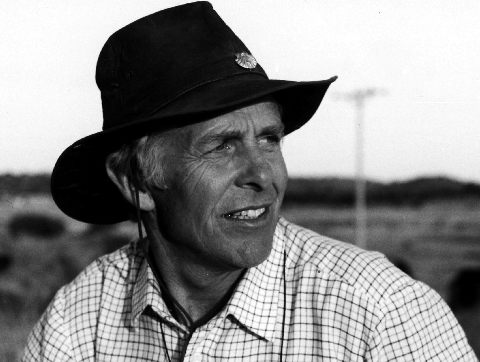
Robin Hanbury-Tenison, who led a Royal Geographical Society expedition to
preserve the Mulu rainforest, faced his greatest challenge when he survived a
gruelling seven-week life-and-death struggle with COVID-19.
One moment the man who had survived enough adventures to rival Indiana Jones was
skiing down the French Alps, a few days later he was battling for his life.
Robin Hanbury-Tenison, awarded a gold medal by the Royal Geographical Society
for exploring South America, had been laid low by a deadly germ that was killing
millions around the world.
He was rushed to
Derriford Hospital in Plymouth, where doctors and nurses began an intense
effort to save his life.
Robin’s condition was so serious that he was placed in a medically induced coma;
which left him unconscious for the next five weeks. During that time his lungs
began to fail; so doctors performed a tracheotomy and placed Robin on a
ventilator. Then his kidneys faltered; so a dialysis machine was the next
machine to save his life.
“I was in a pretty bad way. I was on a ventilator, experienced multiple organ
failure, dialysis, a tracheotomy and severe sedation delirium. I was drifting in
and out of consciousness, hallucinating a lot, talking to 8-foot pythons. I
really didn't know what was going on,” Robin later recalled.
Things were so severe that his family was told Robin had a 5 per cent chance of
survival.
But the Grim Reaper was in for a surprise.
When all hope seemed to be lost, when family and friends feared the worst, Robin
had a breakthrough moment.
Robin wasn’t giving up because he had a powerful albeit unknown ally waiting
just outside the door to help save his life.
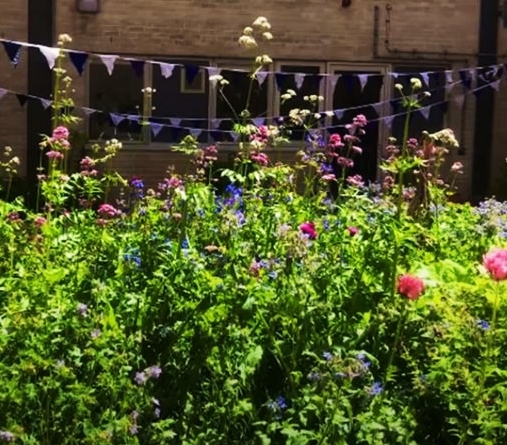
Unbeknownst to the unconscious Long Rider, Derriford Hospital had created what
became known as “the secret garden.”
The Power of Mother Nature
While Robin battled for his life, garden designer
Tom Massey was dealing with disappointment.
Tom was due to display his talents at the
Chelsea Flower Show, the world’s most famous flower and garden exhibit.
Though normally attended by members of the British Royal Family and thousands of
visitors from around the world, the global pandemic had halted the horticultural
event which has been a mainstay of British life since its inception in 1912.
When the 2020 Chelsea Flower Show was cancelled Mr. Massey began looking for an
alternative home for his beautiful plants. That’s when he learned that the NHS
staff at Derriford Hospital wanted to create a special space that would provide
emotional encouragement to patients like Robin who were struggling for their
lives.
|
|
 |
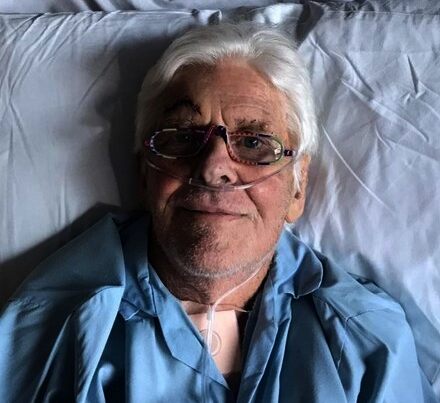
Robin’s family had been told that a man of his age was unlikely to pull through. But thanks to the superb efforts of the NHS staff, including ICU Doctor Ruth Creamer and rehab nurse Kate Tantam, by late April Robin was no longer in critical condition.
Yet he was physically weak, emotionally fragile and had eight painful stitches
across his forehead after falling off his bed. Then everything changed.
To Robin’s surprise the ICU staff wheeled him out of his hospital room, pushed
him down the hall and took him through a door that led him into the healing
sunshine basking over the secret garden.
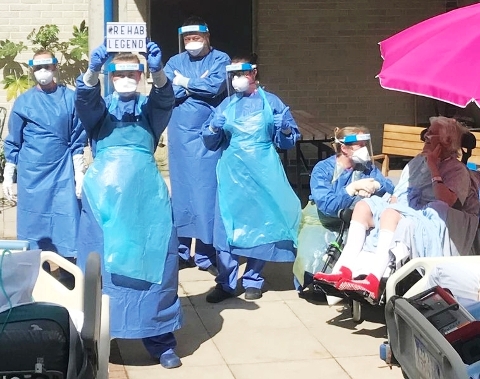 |
“Taken by my nurses, those guardian angels, I was wheeled into the healing
garden. I opened my eyes, felt the warmth of the sun on my face and saw the
flowers. That was when I knew that my life had been saved by the healing
power of Nature. I knew I was going to live," Robin said from under the pink
parasol. Photo courtesy of BBC. |
Though the machines had saved his life, that was the moment Robin’s emotional
recovery began, when he was aided by the smell of flowers and the soothing balm
of fresh air.
Mercy, Love and Support
After 49 days in hospital and having survived a dance with death, the famous
explorer made one of his most important journeys.
The medical team who treated Robin considered his recovery nothing short of
miraculous because of his age, the seriousness of his condition and the length
of time he spent in ICU. Now the doctors, nurses and support staff who had
played a part in his recovery were applauding and cheering as he was pushed in a
wheel chair down the long corridor leading to the hospital’s front door.
Robin described the sight of his departure.
‘To be clapped by that huge team of dedicated, kind, hugely skilled and
determined doctors and nurses, many of them in tears with relief that I had
beaten the virus, was quite overwhelming,’ he said.
Just as Robin was about to be pushed up the ramp into the ambulance to go home,
someone shouted: ‘Look to your right!’
And there, behind a glass wall, he spotted the team from the intensive care unit
who had helped him cling on to life. Dressed head to toe in personal protective
equipment, they too were waving him off.
“I was completely euphoric, furiously waving back at them. I weep now when I
watch the video footage. I’m just so grateful for the care I received.”
The Road to Recovery
On May 4th
Louella Hanbury-Tenison informed family and friends, “He’s
Home.”
Robin had returned to the
family farm located on Cornwall’s
Bodmin Moor.
But as Louella explained
in subsequent emails, even though Robin’s life had been saved, the ravages of
the Covid virus had devastated her husband’s previously robust health.
Whereas most people would have been tempted to rest, recover, sleep and watch
the telly, anyone who knows Robin and Louella Hanbury-Tenison won’t be surprised
to learn that they instead made two bold public announcements.
With Louella’s help, Robin was determined to regain his strength and, because
they had recognized the secret garden’s physical and emotional power to aid
recovering patients, they announced a plan to use Robin’s road to recovery for a
noble cause.
“Everybody should benefit from the power of a healing garden,” Robin said,
“Including the staff that work so hard and need a break. We should have healing
gardens in every hospital.”
To bring about this worthy goal, Robin pledged to raise £100,000 to help create
another garden at Cornwall's Treliske Hospital.
“Nature does make a difference. I think every hospital should have a healing
garden. I believe this one saved my life. Now having beaten the virus, I want to
ensure that as many patients as possible can experience the healing powers of
fresh air and nature, and to raise money for more ICU rehabilitation gardens,
starting with Cornwall.”
To prove his point, Robin promised to climb Cornwall’s highest mountain, Brown
Willy, on October 3rd, exactly five months after his release from
hospital.
The only problem was that Robin wasn’t strong enough to walk.
Beating the Odds
In the months that followed Louella’s emails described Robin’s struggle to
regain his health.
May 4th – “He
is doing well learning to walk again, balance, wash, dress and feed himself. His
journey is not over by any means. But he has made it home for his 84th
birthday later this week. I hope that in sharing the last seven weeks with so
many friends it has helped you all to view this virus with huge respect and that
Robin’s experience will remind you to stay safe and keep well. We hold you all
in our hearts and can’t thank you enough.”
May 18th – “We
are on the long road back to health and normality but it does now seem that the
story didn’t, and shouldn’t, end with his homecoming. No-one knew; and really
this is only coming to light as the long-term Covid-19 patients who survive are
being discharged to rehabilitation units or home, quite how much more care they
will need and for how long.
My
own patient seems to be doing incredibly well. Everything is exhausting and so
our lives have gone into slow motion, but the exciting aspect is watching
tangible progress on a daily basis.
To
paint a picture of getting over this beastly virus, and as a warning just in
case anyone thinks the isolating and social distancing is going on for too long,
the doctors at Derriford told me that every week in intensive care equates to a
month of recovery time. This seemed extraordinary when they told me that, but
when Robin got home and I saw how tiring every action is I know this prognosis
to be realistic. His new best friend is his zimmer frame, and they trundle back
and forth along our veranda or up and down the hall, stopping to take short
rests before ploughing on.”
The news items are all bombarding us with corona virus facts and statistics and
many of us no longer want to watch or listen to any of it. Sticky blood,
clotting, strokes and heart attacks, brain damage, permanent damage to lungs and
kidneys, loss of feeling, taste, smell and more. It is all terrifying.
|
|
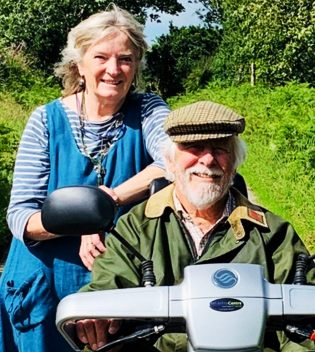
July 1st – “We were lucky enough to be lent a very sturdy mobility scooter which transformed our lives early on in the recovery process. For a month I have walked along behind as we trundle daily three miles there and back to the lake out on the moor. The path is safe for a three-wheeler and fine for my pounding feet as I almost run to keep up. Then last week it occurred to me that Robin had the easy bit and whilst I was getting fitter it was actually his turn to start walking. The scooter is, in effect, a treadmill which actually goes somewhere and there is no need to use walking sticks, just hold on and keep a balanced and steady pace. Yesterday Robin walked just over a mile. A month ago he could walk barely 100 yards. Brown Willy here we come!” |
August 1 – “Nothing is easy with Robin's recovery and we have good and bad days, exhaustion being a major part of it. But he is up to two miles a day, holding onto and striding along behind the mobility scooter, putting a new slant on just what you use a disability buggy for! He needs to keep training. It is very tiring for him but he absolutely wants to get well and fit again.”
eptember 1 – “How quickly the months have gone since Robin came back from hospital. We were told every week in intensive care equates to a month of recovery time, so 5 months from his homecoming would be the perfect time for a fundraising challenge to thank the NHS. This means that from 3rd May when he could barely walk and was learning to talk again my athlete is now honed and ready for the off!”
Climbing Cornwall’s Mountain
October 4th –
“Mission Accomplished! You
will be relieved to know that this will be my last update on Robin’s
recovery. We have worked him hard to get to this stage and it was, as we knew it
would be, a real challenge for him. We hadn’t factored in Storm Alex and 60 mph
winds on the top of Brown Willy but we made it. We walked back to the Jamaica
Inn to dry out and reflect on the last five months of determination that got us
five gruelling miles today.”
|
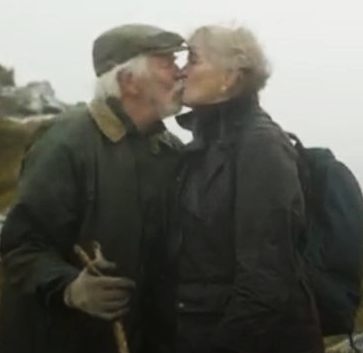
After having raised
£76,000 to build a second Secret Garden, Robin and Louella celebrated with a
Victory Kiss! Photo courtesy of BBC. |
 |
Never Give Up!
Louella concluded by quoting from The Encyclopaedia of Equestrian Exploration,
wherein Robin wrote,
“The will to survive is more fundamentally important than any pill, lotion or
powder found in your first aid kit! This invisible force will help you to
overcome obstacles that seem quite impossible at the time. Unlike taking a
course in first aid, one can’t be taught how to tap into this secret part of
your soul. What you must comprehend is that your determination to survive is the
single most important factor in any emergency. No matter how hopeless the
situation might appear, you must never give up. Ever! Hope gives you pluck and
comfort. This fundamental rule applies to every situation a Long Rider may
encounter. Regardless if you are lying in pain or are facing an emotional
disaster, sheer determination is what separates the survivors from the
statistics. When accidents happen, you must learn to call upon the hidden
reserves of strength and courage which lie deeply buried within your own soul.”
“I
can only suppose that this is what Robin did to beat the odds stacked heavily
against his survival. If Robin’s story has helped any of us to take this
horrible virus seriously then I am pleased to have shared it with you. We thank
you all, and please stay safe and well through the next few difficult months.
With all our love,
© COPYRIGHT 2001 – 2020
Robin and Louella”